Historic Footnotes

To Granby, with Love
|
Originally published in June 1988.
I say it simply—unashamed and unabashed—I love this town.
Granby Drummer (https://granbydrummer.com/category/history/page/9/)
Originally published in June 1988.
I say it simply—unashamed and unabashed—I love this town.
On graduation day, high school seniors receive their diplomas and head off to college or the workforce. Each high school diploma has three signatures: the superintendent, the principal and the chairperson of the Board of Education. For some Granby graduates, those signatures will look familiar because many had a parent serve as the chairperson of the board, including myself.

Originally published May 1987: If the words “Historical Society” evoke an image of grim reverential silence and dull stodgy people—you have not visited the Salmon Brook Historical on a Thursday morning.
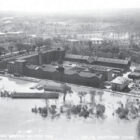
On Sept. 21, 1938, a major hurricane wreaked havoc along the eastern seaboard, especially in New England. Connecticut lost over 680 lives from this storm and Hartford was flooded so badly that the Park River was buried under the city so such an occurrence would not happen again. After the 1938 hurricane, the Granby school district, along with many others, had students record what they remembered from the storm. Below are excerpts of how students who attended the one-room schools in Granby described the 1938 hurricane.
The Neighborhood News was a weekly Granby newspaper, which ran from 1939 to 1943. It was produced by two children, Buddy Pendleton and Mary Teale. Buddy, age 6, was the editor, and Mary, age 6, the assistant editor, although sometimes her older sister, Christine, age 11, would fill in for her.

Carol Laun wrote many articles about the iconic Granby Oak, also referred to as the Granby-Dewey Oak. Three of her columns, spanning several decades, combine to commemorate Arbor Day, celebrated on April 29.
In 1872, the first Arbor Day was celebrated in Nebraska. J. Sterling Morton, a resident of Nebraska City, was a tree enthusiast who recognized that the lack of trees, and all their benefits, in tree-bare Nebraska Territory was a serious deficit to the land and its people. When he became secretary of the territory, he was in a position to advocate strongly for the widespread planting of trees and is credited for bringing the holiday into being.
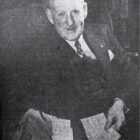
Although spring is in the near future, we can almost certainly expect another winter storm in late February or March. There is always the possibility of an April Fool’s Day blizzard as we had in 1997. While we have television and radio meteorologists as well as the National Weather Service to alert us to incoming storms, that was not the case in the first half of the twentieth century.

From The Archives: Historic Footnotes by the late Carol Laun (1934 – 2021)

From The Archives: Remember iceboxes?