Town/Govt
Summer Safety Tips
|
Summer is almost upon us along with its inherent risks to life and safety. Two big fire safety concerns are outdoor cooking/grilling and fireworks.
Granby Drummer (https://granbydrummer.com/author/brian-long-granby-fire-marshal/)
Summer is almost upon us along with its inherent risks to life and safety. Two big fire safety concerns are outdoor cooking/grilling and fireworks.
During an emergency it is important that emergency personnel quickly identify your house when responding. Finding your home, especially at night, is quite challenging if your street number is hidden, unreadable, unlit or missing entirely. This can delay responders from getting to your emergency quickly.
On March 8 we return to daylight savings time, setting our clocks ahead by one hour. This is a good reminder to replace the batteries in smoke alarms—Change Your Clock / Change Your Batteries.
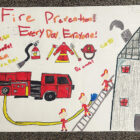
Two Wells Road Intermediate School students have been selected to represent the Town of Granby in the Connecticut 2026 Fire Prevention Poster Recognition Program. This year’s theme is “Fire Prevention—Everyone/Every day.”
The Granby Fire Marshal’s office and Lost Acres Fire Department are working in coordination with the National Fire Protection Association® (NFPA®) to raise awareness about the risks associated with lithium-ion batteries and ways to minimize the dangers.
According to the National Fire Prevention Association, holiday trees and decorations account for about 400 home fires annually. This results in approximately three deaths, 28 civilian injuries and over $17 million in property damage.
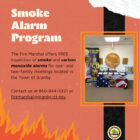
At 2 a.m. on Sunday, Nov. 2, daylight savings time will end and we will set our clocks back one hour. That it is a good reminder to replace smoke alarm batteries. It is also a good time to check the age of your smoke alarms. The life expectancy of a smoke alarm is 10 years. If you are unsure as to the age, it would be a good idea to replace the unit.
According to the National Fire Protection Association, smoke alarms reduce the risk of dying in a home fire by more than half (54 percent). Meanwhile, roughly three out of five fire deaths happen in homes with either no smoke alarms or no working smoke alarms.