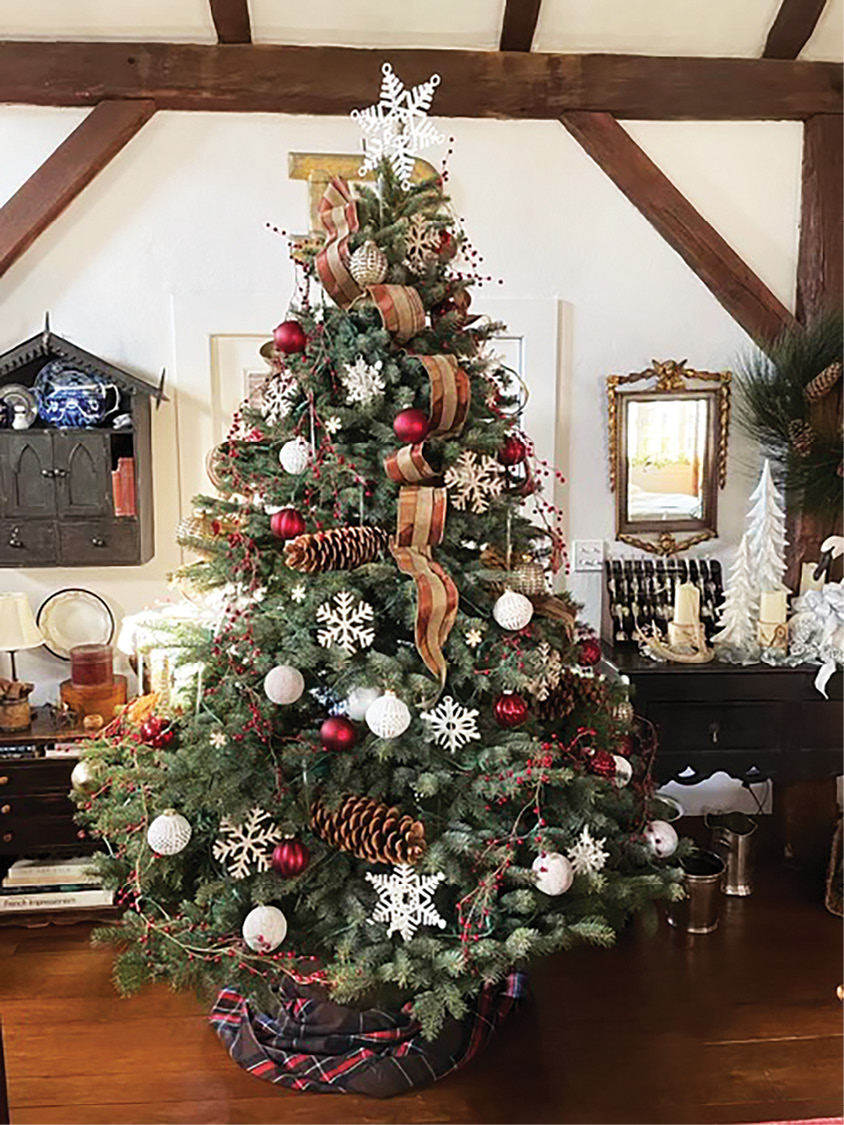
If you’ve ever wondered how and why the evergreen tree became an indispensable component of our Christmas decorations, here’s an answer to that question. It goes back to pagan times.
Northern European pagans believed that the sun was a god who went through a period of poor health during winter, being functional for a greatly diminished number of hours compared to its healthiest days mid-summer. To remind them the god would eventually feel better and spur the re-growth of all plants, the pagans would decorate their homes with the boughs of trees that managed to stay green in the midst of winter. They chose the shortest day of the year for this exercise, which corresponded to the winter solstice.
Other cultures had similar traditions. Not having much in the way of evergreens, the ancient Egyptians used palm fronds to encourage the return of their hawk-headed god Ra, who wore the sun as his crown. Ancient Romans used fir trees to decorate their temples during Saturnalia, a mid-winter festival to honor Saturn, their god of agriculture.
Early Christians were not all that gung-ho about this kind of thing. They believed that those who decorated with plants and trees were heathens, and here is where there is some dispute as to who was first to counter that philosophy and center Christmas rituals around a tree. The Eastern European cities of Tallinn in Estonia and Riga in Latvia both claim to have done it first. Both cities had an official brotherhood of unmarried merchants and shipowners who erected a tree in their town square at Christmas, around which they danced. When the celebration was over, they lit the tree on fire.
Germans were using evergreens in their public Christmas rituals around this same time. One of their favorite displays was a fir tree decorated with apples, representing the Tree of Knowledge in the Garden of Eden, but it was the German monk, Martin Luther, who is responsible for the tree becoming a part of indoor decorations.
The story goes that Luther was taking a mid-December evening stroll through a pine forest near his home in Wittenberg when he was awed by the thousands of stars twinkling through the branches of the trees. He immediately connected the vision to the ascending of Jesus into heaven after his birth here on earth. He rushed home and brought in a small evergreen, covering it with lighted candles to recreate the heavenly scene. The year was 1536.
Germans quickly adopted this ritual, covering their indoor trees with gingerbread, fruit and the first of what we today would call ornaments. In fact, the custom was brought to America by German settlers. German soldier Hendrick Roddmore was captured at the Battle of Bennington in Vermont in 1776. He went to work on Samuel Denslow’s farm in Windsor Locks where he put up and decorated a Christmas tree in the Denslow home for the next 14 years.
Whether it’s true or not, an amusing legend has it that, as Washington was crossing the Delaware on Dec. 25, 1776, German mercenaries fighting for the British were busy decorating trees and drinking heavily. They became so drunk they could not adequately mount a defense and lost the ensuing battle.
In spite of the fact that we fought a war to separate ourselves from the British, it was the British who were really responsible for Americans adopting the use of a tree as the pivotal focus for holiday decoration. In 1848, Queen Victoria erected a Christmas tree provided by her German husband, Prince Albert. The Illustrated London News published a sketch of the Queen’s tree that was reprinted in a Philadelphia newspaper. East Coast women “went wild for the heart-warming scene,” and the Christmas tree became the center of indoor decorations in American homes.
Final note: In case anyone is thinking of replicating the historic tradition of having real candles on their tree—DON’T DO IT!