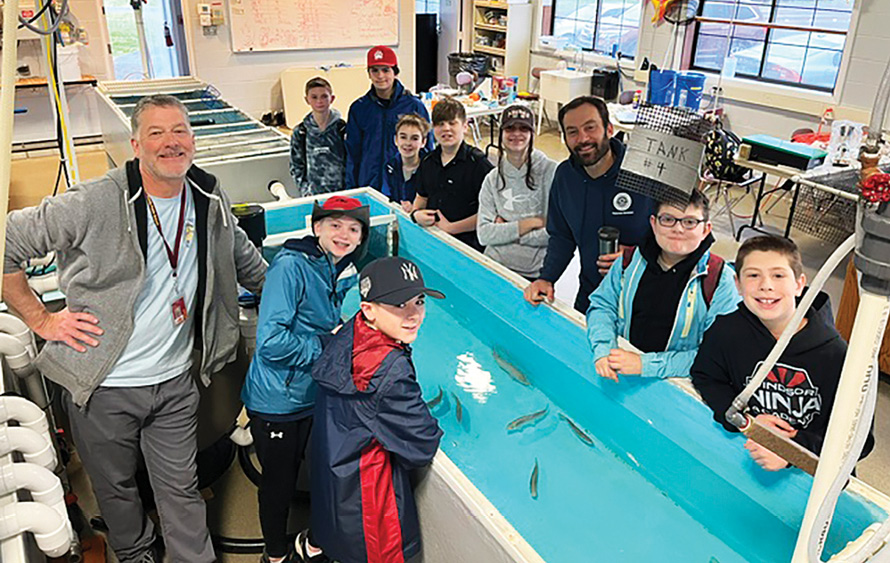
Middle school students at the Salmon Brook Ecology Center have learned that the term “brown trout” might be a misleading common name for the species. Their scales include special, pigmented skin cells called chromatophores, which allow brown trout to routinely change colors.
Much like the changing leaves of autumn in New England, brown trout can shift colors seasonally, ranging from olive green to grayish brown along their backs, golden-yellow to copper along their sides and creamy white to silver along their bellies. At times, the changing colors are believed to be the result of hormonal shifts, similar to the way many birds change plumage during mating and breeding season. At other times, brown trout can rapidly change colors to be better camouflaged within their environment.
In short, brown trout are not always brown. And they are never uniformly one color.
Ted Goerner is a recently retired science teacher who continues to lead the ecology center at Granby Memorial Middle School.
During a recent tour of the ecology center, Goerner explained that last year students witnessed the amazing color transformations of brown trout firsthand. “Students painted one of the holding tanks with colors from a river ecosystem,” Goerner said. Using special, nontoxic paint, the students brushed the sides of the tank in shades of green, brown and black to go along with the sandy-colored bottom.
After a few weeks, the color transformation was obvious. “The fish raised in the tank that the students painted were much darker along their dorsal fins,” Goerner explained. “Their backs were much darker than those raised in the factory painted tanks. All of the other conditions were identical, but the different colors inside the tanks led to obvious changes in the fish skin cells.”
Goerner suspects that the fish raised in the tank painted by the students will have an advantage when they are released into the Farmington River. “It’s difficult to say for sure, but I’d suspect that the color change we saw in those fish will help them blend in quicker than their peers,” Goerner noted.
Brown trout are not native to the Farmington River watershed, but they are not invasive either. Instead, they are an adapted, naturalized species that is much easier to raise in captivity and release into the wild than the native brook trout.
“We’d love to figure out a way to raise brook trout,” Goerner acknowledged. “But they really struggle in captivity. And brown trout are a great fish for students to learn about local water ecology.”
Each year, a lot of effort goes into getting the ecology center ready for a new batch of “fry,” or the term for recently hatched trout. Before the fish can be introduced to the tanks from Connecticut DEEP, glass beads must be added for texture to the bottom of the tanks and two different strains of beneficial bacteria must be introduced to the water to achieve the right balance of water nutrients. “It takes about two to three weeks every fall to get the water ready for the fish,” Goerner explained, as he awaited a new shipment of tiny glass beads and the first group of students to arrive.
This year, the Drummer will follow the story of the brown trout that are raised by students at the ecology center, from the fry and hatchlings to their release into the Farmington next May.