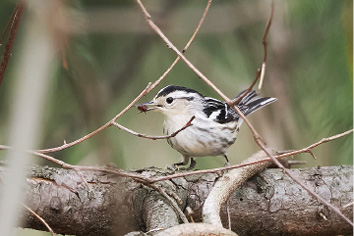
In late spring and early summer, many birds take up hunting. This is true even for birds that primarily survive on diets of nuts, berries and seeds throughout the fall and winter. Common birdfeeder species, such as northern cardinal, tufted titmouse and black-capped chickadee, shift from foraging for fruit and seeds to hunting insects, spiders, beetles and caterpillars.
So, what accounts for these seasonal shifts in diet and behavior?
“Hungry nestlings,” said Connor Hogan, director of the McLean Game Refuge. “After bird eggs hatch, we see an explosion in our bird population. And most young birds rely on a diet of insects, caterpillars and a host of other invertebrates.”
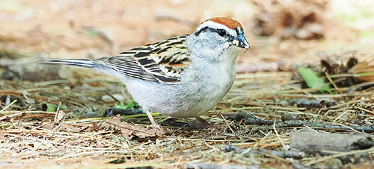
If you listen closely, you might be able to hear this seasonal shift. As Hogan noted, “The birdsong you heard this spring quiets in the summer as the birds shift from singing to attract mates to hunting food for their young.” And, he joked, “It’s also probably harder to sing with a beak full of insects.”
Even for insectivores, or birds that feast on insects year-round, this time of year still comes with a dramatic increase in hunting requirements. For example, a mating pair of warblers will hunt from dusk to dawn to catch thousands of extra caterpillars for their young.
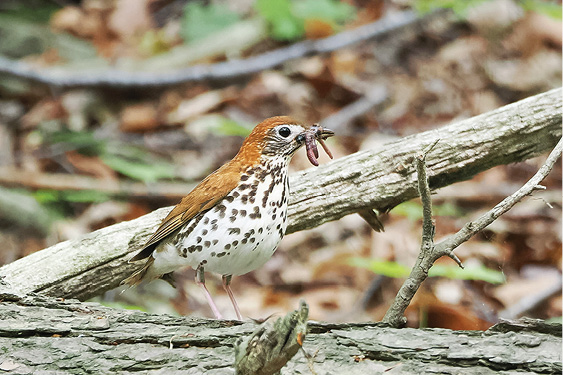
Managing for abundant, healthy insect populations is a crucial element to maintain and grow healthy bird populations, and both invertebrates and birds are best served by conservation plans that consider the whole forest.
At the McLean Game Refuge, Hogan and his team of forest rangers model their management plan around what we know about pre-colonial forests. As Hogan explained, “We have to work with humility because there is a lot we don’t know and a lot we can’t know about pre-colonial forests. But one of the things we do know is that forests were shaped historically by regular disturbances, such as fires, hurricanes and ice storms. So, we’ve developed management plans that generally mimic these forms of disturbance.”
For example, when selecting sites to thin trees, Hogan and the rangers seek out historically disturbed areas, such as reclaimed farmland, and thin the trees similar to the way a hurricane would do it. As Hogan explained, “We want to make sure our forests have a diverse range of tree species and ages. A healthy forest not only has species diversity, but age diversity, or a combination of young and old trees.”
This year, Hogan said, the model shows clear evidence of paying off with a steady increase in bird species that rely on early successional habitat, or areas that have been recently disturbed. In particular, Hogan has been excited to observe increased populations of prairie warblers, chestnut-sided warblers, blue-winged warblers and the omnivorous eastern towhee. “All of these species are declining in Connecticut,” Hogan noted. “But we have increased populations and breeding pairs here in the Game Refuge.”
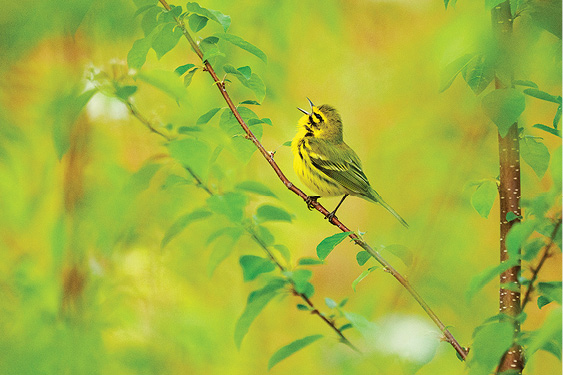
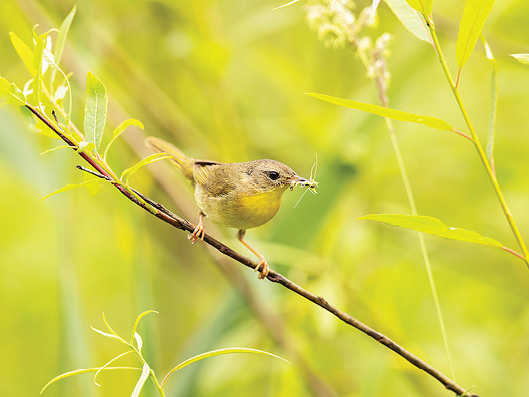
Hogan encourages hikers to be on the lookout for the warblers hunting for caterpillars on the oak trees, as he and the rangers continue to see the forest through the trees.