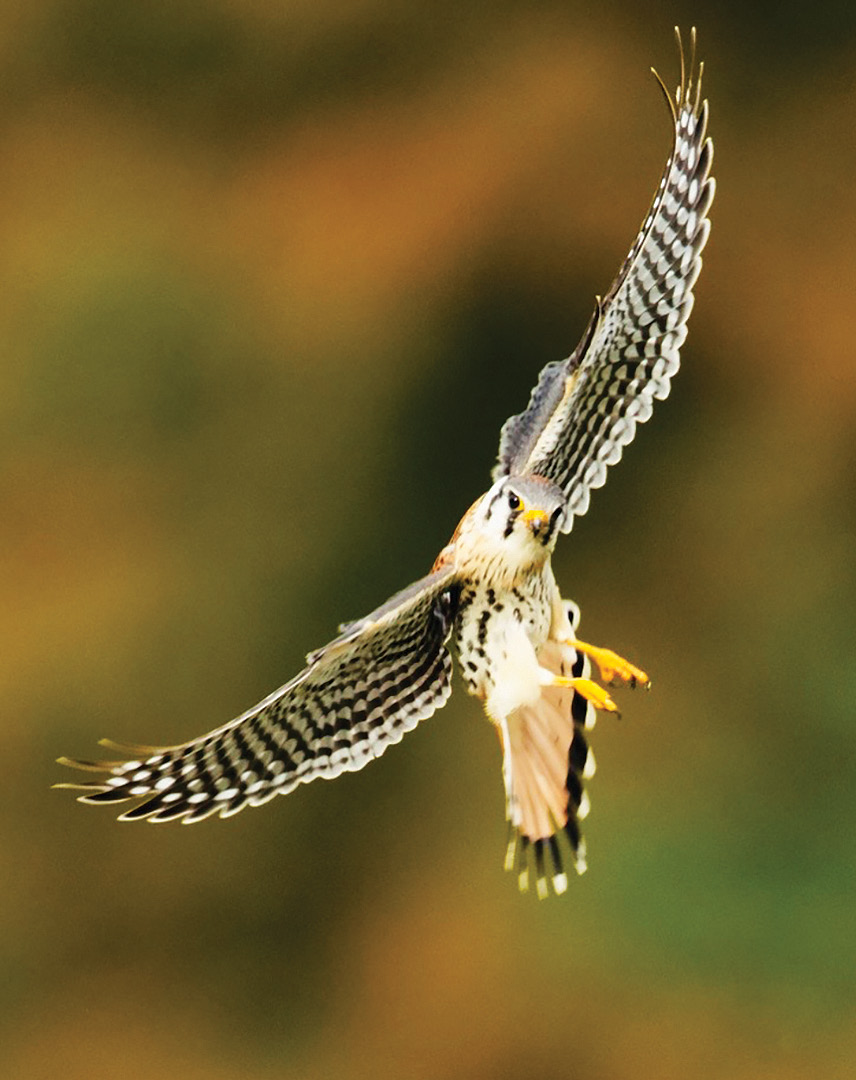
Along with so many of New England’s songbirds, kestrels are mostly heading south to escape the cold temperatures and diminishing food supply. The smallest of the falcons, Falco spaverius, is unlike most of the other falcons in that instead of seizing their prey in mid-flight, they hover above it and dive to the ground to capture their insect and small rodent meals. Those small rodents are hard to find once the ground freezes and is covered with snow, hence it makes sense to head for warmer territory in the southern United States or Mexico.
Often called “sparrow hawks,” kestrels are not hawks, although small birds are on their diet plan. The easiest way to tell the difference between the two groups is in the wings. Falcons have pointed wing tips whereas hawks’ wing tips are rounded.
Falcons return from their winter vacations around the end of March, just in time to find a mate and begin a family. Three to seven cream-colored eggs with brown splotches are deposited in a woodpecker’s hole, a crevice on a building or in a specially constructed nest box such as the one on the Holcomb Farm Tree Trail. Usually very little if any nesting material is provided.
In about a month, the eggs hatch. The female does most of the incubating, with the male providing food for her until the eggs hatch. Instead of feeding her at the nest while she incubates, he perches nearby and calls her out. She flies away from the eggs and accepts the food he has brought before returning to the eggs.
After the eggs hatch both parents are on food patrol for about another 30 days. Once fledged, the youngsters stay with the parents learning to feed on their own for several weeks, which for us in Connecticut is a good part of the summer.
One of the most beautiful local birds, kestrel males are easily identified by their blue-gray wings and orangey-red tail with prominent black bars on the wings and body. Females do not have blue wings or red tails, but like the males, have the black bars on their wings, which are brown, and body, which is cream-colored. The larger females measure up to 12 inches. Males can be as small as nine inches.
Kestrels are speedy flyers, being clocked at 20 to 40 mph! Although they do not have a wide variety of calls, they make a sharp high-pitched “klee klee klee” when excited or alarmed.
Kestrels favorite hunting locales are bird feeders and open grassland, farmland, vacant lots and power line rights-of-way. A decrease in agriculture and an increase in development has led to less open fields, decreasing numbers of these beautiful birds.
Experienced Granby birder John Weeks notes that, “For decades, the species has been in deep decline in the Eastern U.S., whereas out West, they seem to be holding their own. At my hawkwatch site in Granville, we counted over 600 kestrels during the fall of 1999. This year, I’ve tallied 34 so far, and I probably won’t see 50.”
A field biologist known to Weeks nets and examines kestrels returning from down South in the spring. The birds coming back now weigh less than they used to. His theory is that heavy use of pesticides on farms in the southeast is wiping out the birds’ principal food sources.
In addition to potential lack of winter food leading to less vital specimens, kestrels are themselves preyed upon by great horned owls, red-tailed hawks, coyotes, bobcats, crows and ravens—all of which are common in our area.
Drummer readers may remember the June article on the Holcomb Farm page about the installation of the kestrel nest box on the Tree Trail. Unfortunately, the box was not successful this season, as it was repeatedly taken over by other species. Keep watch next spring; we’re hoping for a better outcome.