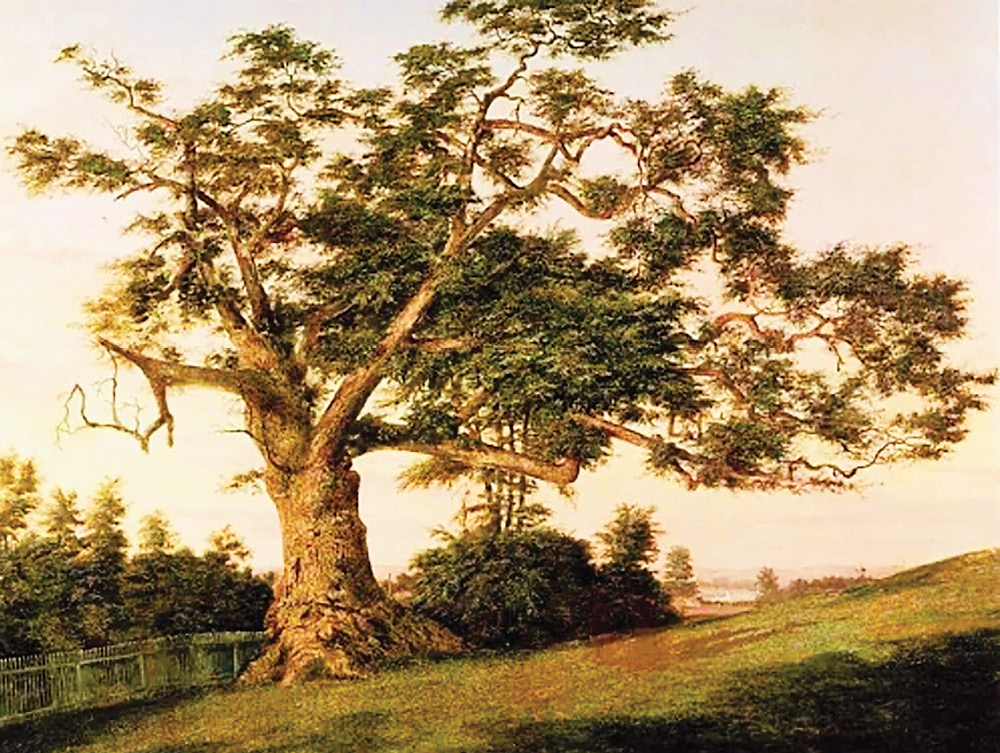
Cared for and revered by many, the Dewey-Granby Oak on Day Street is a white oak. The white oak is the Connecticut state tree, formally designated as such by the state’s General Assembly in 1947. It was a choice made easy considering the importance a white oak played in protecting our independence.
In 1662, Connecticut colonists had written a Royal Charter, which declared independence from Great Britain’s King James II. Knowing that the king’s representatives were aiming to steal the charter, therefore nullifying the declaration, the colonists hatched a plan.
At the evening meeting where the two sides of this conflict were present, it couldn’t have been an accident that suddenly all the candles went out. In the darkness, the story goes, the charter was placed in a hollow in a nearby giant white oak. When the candles were re-lit, the British could not find it and Connecticut’s status as an independent colony was maintained.
Designated as The Charter Oak, the original tree was located on what is now Wyllys Street in Hartford. It is estimated to have originated in the 12th or 13th century and was destroyed in a severe storm in 1856. It was an especially large specimen. Legend has it that as many as 20 men could stand inside its hollow trunk toward the end of its life.
According to Doug Tallamy, an entomologist and wildlife ecologist, oak trees are an essential keystone species. “They sustain a crucial and complex web of life both above and below ground. Their enormous root systems make them champions of carbon sequestration, soil stabilization and watershed management.” The genus Quercus supports more life, from single-celled organisms to mammals, than any other on earth. For example, oaks feed more than 500 species of butterflies and moths. And what would our squirrels do without the oaks’ acorns!
As part of honoring America’s 250 years as a country, consider a visit to Granby’s graceful old oak on Day Street. Over the years, some limbs have been lost, but its presence is still remarkable, thanks in part to care provided by Arborworks in association with the Granby Land Trust.
Editor’s note: Readers may also enjoy the article entitled “Granby Oak II thrives thanks to historical society foresight” in the October 2025 issue.