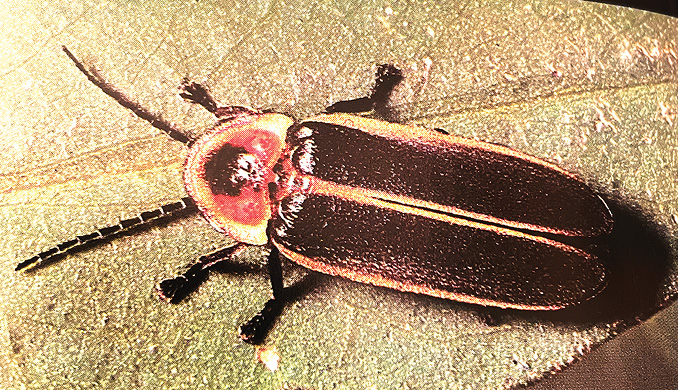
One of the joys of summer, no matter what one’s age, used to be watching the fireflies flitting about one’s back yard during the evenings of early summer. What child hasn’t trapped a few in a glass jar and kept them in the bedroom for the night? That is beginning to feel like a bygone pleasure, as it is becoming hard to find them anymore.
There are more than 2,000 species of fireflies world-wide, and there may be as many as 170 right here in North America. They are most active in temperate and tropical climates, but everywhere their numbers are declining. The Xerces Society for Invertebrate Conservation estimates that world-wide 14 percent are threatened with extinction, including one-third of those in the United States and Canada.
Scientists believe the cause of this depletion is the lack of suitable habitat. Fireflies are actually beetles, in the order Coleoptera, not flies (order Diptera). As such, they have what is called complete metamorphosis: the egg hatches to an active larval form that becomes a sedentary pupal form from which the adult insect emerges. The larval form of the insect (known as a glowworm) is most sensitive to habitat.
What is a good habitat for a glowworm? A place that is warm, humid and dark. And there we have the major problem: light pollution! Obviously, fireflies have never had large populations in cities, but now even suburbs are well-lit all through the night. Even private homes in rural areas have back porch lights frequently left on, and many homes have motion sensor lights for protection and curiosity (what wildlife is roaming around out there while we’re asleep?) To make matters worse, the warm yellow glow of the old incandescent bulb has been replaced with high intensity full spectrum lights—daylight at night! Add to this, the use of pesticides, and it’s easy to see why we aren’t seeing many fireflies anymore.
The Xerces Society is encouraging the establishment of firefly sanctuaries. The first one in the United States is in New Canaan and is comprised of six acres managed by the New Canaan Land Trust. It is a mixture of meadow and woodland and has trails open to the public. The best viewing of fireflies takes place from late June through mid-July. Visitors may apply mosquito/tick protection in the parking lot, but not on the trails. The Xerces Society compiles data from New Canaan and firefly researchers across the country to increase its knowledge of the life cycle patterns.
What makes a glowworm glow? A bioluminescent molecule in shades of yellow to green that is primarily a sexual attractant in the adults—the males flashing and the females responding. The chemical is present in the larval worm-like form, during which time its toxicity helps to allow the glowworm a long life—up to two years. The pupal stage lasts from weeks to months, depending on the species, and the adults live only two to four weeks, which explains why we see them for such a short time in the early summer.
The glowworms live in the grassy or leafy layers of the woods or the edge of lawn areas that have not been poisoned with pesticides and herbicides. In late winter, you might see them on the lower trunks of trees.
If you want to learn more about fireflies, Google Photinus pyralis, the common eastern firefly. For fun, Google The Glow Worm song, written by Johnny Mercer and recorded by the Mills Brothers. Beware: The Glow Worm could become an earworm for the rest of the day.