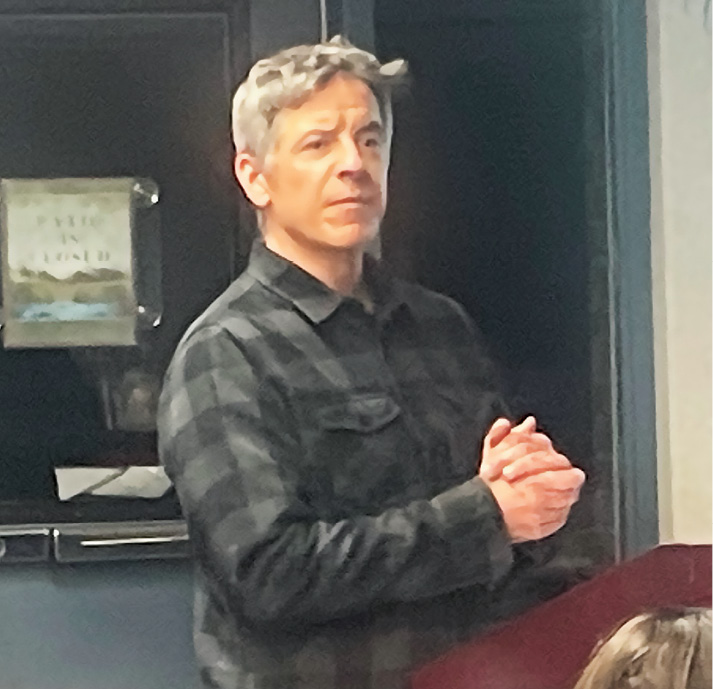
Holcomb Farm’s Joe O’Grady opened his talk at the Granby Public Library on Feb. 24 with this remark, “Sustainability is all about the soil.” He proceeded to back up his comment with facts garnered during his 20 years of studying this basic component of the farming process.
O’Grady noted that much of our food comes from soil that contains minimal nutrients. The once-average 21 inches of topsoil is now six inches, meaning a 15-inch loss of minerals and other nutrients. That combined with a heavy reliance on only nitrogen, potassium and phosphorous (NPK) as the most common soil amendments, has helped to lead to the least nutritious soil in decades.
In the years that O’Grady has been Holcomb’s farmer, he has increasingly added the less known mineral nutrients that bring life back to the soil at the West Granby farm. Cobalt, sulphur, magnesium and iron are among the products he adds. Although in some cases not easy to obtain, they make a remarkable difference in the quality of the soil and thus the vegetables that are grown in it.
Regarding the importance of these minerals to humans, cobalt serves as the core (cobalamin) of the vitamin B12 molecule, a molecule all humans need to act as a facilitator in DNA synthesis, energy metabolism and red blood cell production. Magnesium is essential for more than 300 biochemical reactions, such as energy production, muscle and nerve function, bone health and heart health. It is stored primarily in bones. This mineral is easy and inexpensive to add to the soil as it is commonly known as Epsom salt.
Iron is another absolutely essential mineral because it is important in the formation of hemoglobin that carries oxygen via the red blood cells to every cell in every organ. Iron is found in many of the vegetables at Holcomb Farm, such as broccoli, sweet potatoes, bok choy, Brussels sprouts, Swiss chard and the Farm’s beloved spinach!
Sulphur is a key component of two essential amino acids that form bonds in protein synthesis. Proteins are extremely important in the production of keratin (nails, hair) and in the synthesis of one of the body’s most important antioxidants. It is also an important component of the connective tissues that keep our joints cushioned and flexible, and it is an integral part of the insulin molecule that regulates our blood sugar level. O’Grady noted that in the days before pollution control, sulphur was readily available to the soil. But now sulphur spewed from smokestacks has been eliminated and it must be manually added.
O’Grady noted that Holcomb Farm’s production has “exploded” since his addition of these elements to the soil. “Insects and disease are symptoms of a failing crop, not causes,” said O’Grady. “The root cause is usually an imbalance of the soil chemistry, sometimes even a lack of biological activity. That is what needs to be addressed.”
In 1925, the United States was ranked 8 in the world for life expectancy. We are now ranked 49. O’Grady believes that soil deficient in necessary elements and minerals, leading to nutrient-poor food, is at least partially to blame.