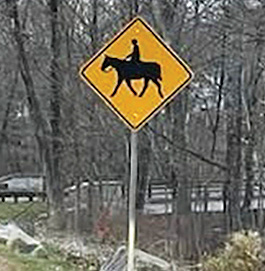
Have you ever driven around a curve in the road and been surprised to find a horse and rider in the road?
To reduce the risk of mishaps arising from these situations, the Granby Horse Council teamed with the Granby Department of Public Works for safety. Horse council members identified several locations where horse barns, trails and road crossings mean there were good odds that horses might be in the road. They worked closely with the DPW to place yellow signs with a silhouette of horse-and-rider at those risky spots to alert drivers to be ready to adjust their driving to match the law and give the horses wide berth. These may help avoid a repeat from a couple of years ago in Granby, when a driver hit the hind end of a horse that was being ridden on the edge of the road—fortunately without lasting physical injuries to horse or rider.
What does Connecticut require of drivers approaching a horse? Basically, slow down, proceed with caution and stop if necessary—do not blow a horn or cause loud or unusual noises that might startle or frighten the horse. (Conn. Gen. Stat. Sec 14-293b)
Rules of thumb: pass a horse or horse and buggy quietly when it is safe to do so, give a wide berth—six to eight feet—and don’t cut back in too quickly. That guidance comes from the Connecticut Horse Council’s Road Safety brochure (see cthorsecouncil.org). As it points out, riders too must share the road safely. For example, riders should observe all traffic rules, ride single file on the edge of the road usually with the flow of traffic, wear bright clothing, stop to let a car pass if it’s a narrow road and signal fast traffic to slow by waving your hand palm down.
With this great cooperation between Granby DPW and Granby Horse Council, there is now less risk to drivers, horses and riders.