
Find it
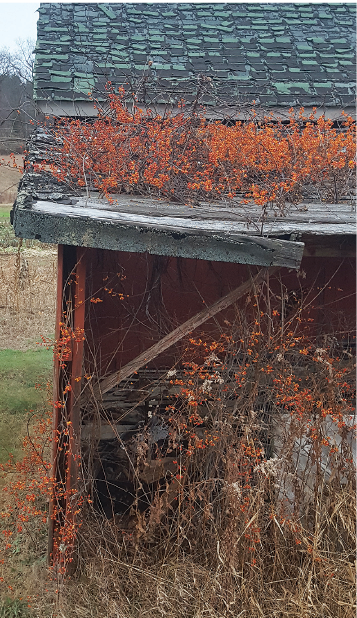
Like the southern “kudzu” vine, Asiatic bittersweet spreads a drapery of death across thousands of acres in the northeast US. Bittersweet is an extremely vigorous woody vine that can grow 60 to 80 feet high, completely smothering small and medium sized trees and shrubs, wrapping tightly around and girdling trunks, covering and depriving leaves of light, weakening trees over time and often pulling them down. In large trees, established vines with dozens of branches growing 6 to 10 feet or more each year, climb trunks and follow branches out in search of sun.
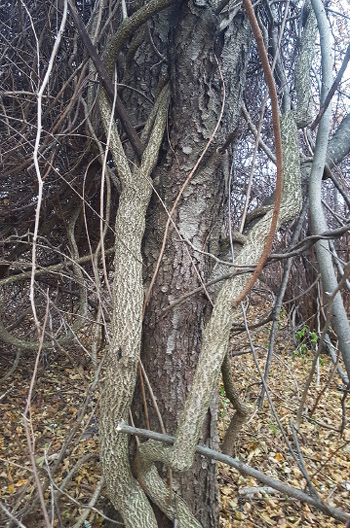
Bittersweet is easy to identify in any season by its glossy roundish leaves, by its speckled bark after leaves have fallen, by its trademark red and orange seeds scattered nearby and by its uniquely bright orange roots. It flourishes in full sun but tolerates shade, and is often found at field edges and in open areas where it has both sun and trees to climb. Seeds readily germinate in shady, moist environments. There is a native bittersweet, but it is uncommon.
Bittersweet is native to Japan, Korea and China and was imported to the US in the late 1800s as an ornamental because of its showy, red-orange fall fruit. Bittersweet has no known biological control and tolerates a wide range of growing conditions. Its seeds are spread by birds and humans and germinate easily. It crowds out native plants and can completely cover trees, shrubs and small buildings.
Remove it
Do not harvest the berries for decoration. Harvesting the bright red and orange berries for decoration helps distribute the seeds and spreads the vine further. Also, don’t plant it.
Bittersweet is so vigorous that all but the smallest plants require multiple strategies. For seedlings and small vines, pull or dig them out, removing as much of the orange roots as possible. Because most seeds germinate in the first year or two, removing seedlings is a durable solution as long as new seeds are not dropped.
For larger vines, cutting encourages them to send out fresh shoots and can appear counterproductive. But multiple cuts a year, for multiple years, weakens the roots and eventually kills the plant. Cut them close to the ground and again several feet up to deprive new shoots of handy trellises to climb. Allow the severed vines above to decay and fall over time, or pull them to the ground if it will not damage the tree.
Mature bittersweet root systems are extensive, stretch out yards in different directions and may support several apparently separate above-ground stems. Digging out established roots can be quite aerobic and satisfying but, because some root fragments are inevitably left behind, periodic monitoring and follow-up is needed. Mowing and burning are not effective control strategies.
As a last resort, use a small brush to carefully paint freshly cut bittersweet stumps with liquid herbicide. With uncut large stems, use a hatchet or machete to hack through the bark, two to four times around the stem and leaving some bark intact, then paint the gashes with liquid herbicide; this allows the poison to travel up into the foliage and down into the roots. Spraying herbicide on foliage is not recommended because of likely injury to other flora and fauna.
Dispose of chopped bittersweet vines with care. If no seeds are present, they can be composted or left to dry in the sun. Vines with seeds need to be bagged and removed, or added to a backyard bonfire.
For more information, pictures and resources, visit GranbyInvasivePlants.weebly.com