In the spring of 2025, visitors to the Granby Land Trust’s Dismal Brook Wildlife Preserve noticed something unusual at the North Marsh: an industrious group of beavers had built a dam directly beneath the footbridge. As a result, water levels rose, the marsh began to resemble a pond, and the altered flow threatened the bridge’s integrity.
The Granby Land Trust was faced with a challenge: how do we protect the marsh, and our bridge, without harming the beavers?
For the GLT Board of Directors, the answer was clear: work with nature, not against it.
A brief history
The Dismal Brook Wildlife Preserve was given to the GLT in 2020 by longtime board member Jamie Gamble to protect its diverse wildlife habitat. “The 210 acres of diverse habitat represents a unique combination of woods, wetlands, open fields, and ridgeline to be cherished by the creatures living here, and nature lovers exploring the landscape,” Gamble said at the time. He also hoped the property could be maintained “in a way that both beavers and humans can coexist in a mutually satisfying way.”
One major improvement the GLT made to the property was the construction of a footbridge over the North Marsh. Designed and built by board member Lowell Kahn and his team at Hartland Building and Restoration Company, the curved bridge blends naturally into the landscape while serving as a viewing platform for the North Marsh. Thousands of people cross it each year.
Enter the beaver deceiver
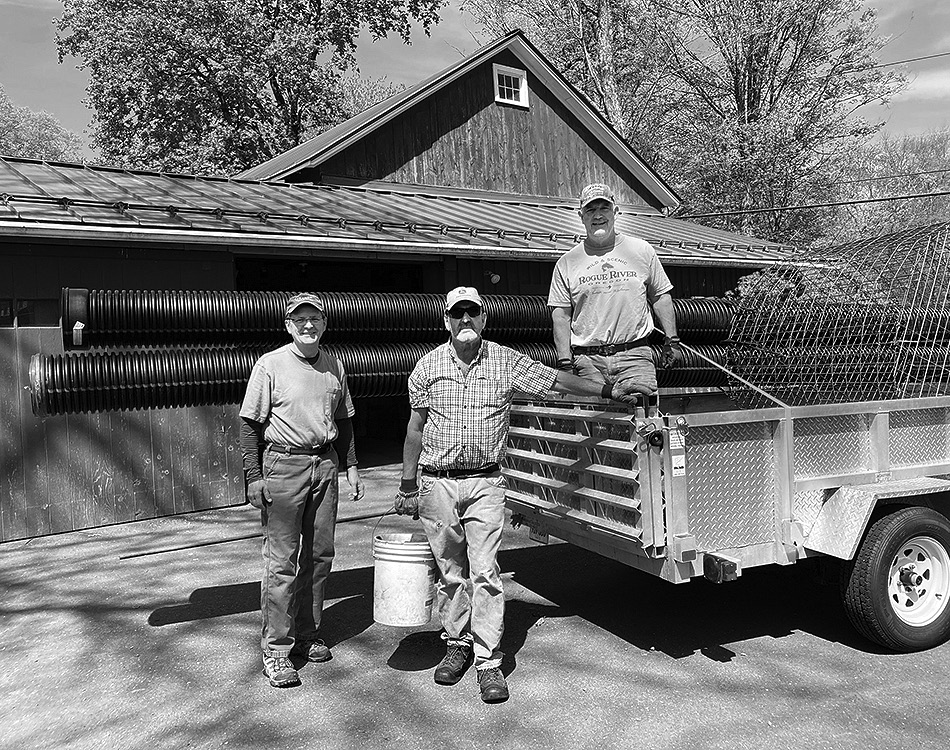
Kahn took the lead, working closely with GLT Vice President Dave Emery to find a solution to the problem. After researching existing designs of something called a “beaver deceiver,” he settled on one he thought would work. He, Emery, and GLT member Steve Perry made a trip to Granville State Forest to see a functioning deceiver, and they immediately knew what was needed for Dismal Brook. They got to work designing and building a beaver deceiver in Emery’s driveway and then installing it in the North Marsh, investing many hours of volunteer time.
Beavers are hardwired to build dams when they hear the flow of running water. The beaver deceiver works by quietly rerouting water through a concealed pipe system, eliminating the sensory cues that trigger dam-building.
The design is both simple and ingenious:
A pipe runs beneath the dam, allowing water to flow downstream
A protective wire cage prevents beavers from clogging the pipe
An L-shaped outlet controls water levels while keeping the flow undetectable (this was an ingenious new addition by the GLT Team)
The result: the dam remains intact, the beavers stay undisturbed, water levels are controlled, and the bridge is protected.
A win for wildlife—and for visitors
The impact was immediate. With dam-building activity reduced, the water flow returned to manageable levels. To repair damage caused by the high water, Kahn developed an engineering plan to reinforce the bridge supports. Emery secured the necessary town permits, and GLT member and local contractor Billy Beach, of Cole and Haley, was hired to complete the repairs.
Today, the pedestrian footbridge is secure, and the wetland ecosystem continues to flourish.
The expanded wetland habitat has attracted an impressive variety of birds, including species not seen here in many years. Among them is the pied-billed grebe, a bird listed as endangered in Connecticut due to wetland loss and degradation.
Working with the beavers
Beavers, often dismissed as nuisances, are in fact a keystone species. A keystone species is an organism—animal, plant or microbe—that plays a critical, disproportionately large role in maintaining the structure and biodiversity of its ecosystem. If removed, the ecosystem changes drastically or collapses—like removing the center, or keystone, of a Roman arch.
Beavers are considered “ecosystem engineers,” and their dams create wetlands that support other species, improve water quality and even help mitigate flooding and drought.
Environmental writer Ben Goldfarb, author of Eager, the Surprising, Secret Life of Beavers and Why They Matter, recently spoke at a special GLT event co-hosted with the Granby Public Library and the McLean Game Refuge, with support from the Granby Education Foundation.
Goldfarb argues that our modern view of a “natural” landscape is wrong, distorted by the loss of millions of beavers trapped from North America’s lakes and rivers. The consequences of losing beavers have been profound: streams eroded, wetlands dried up and lost vital habitat for species from salmon to swans. Today, a growing coalition of “Beaver Believers”—including scientists, ranchers and passionate citizens—recognizes that ecosystems with beavers are far healthier and more resilient than those without them.
Jamie Gamble has long been a Beaver Believer. “I’ve always been impressed with the significant impact the beavers have on surrounding habitat,” he says. “Relentlessly working, and fine tuning the pond and streams, creating nutrient rich places to host a diversity of creatures. They’ve certainly been a guiding inspiration for me.”
A model for coexistence
The success at the GLT’s Dismal Brook Wildlife Preserve offers a hopeful example of how people and wildlife can coexist and even prosper. By partnering with beavers instead of opposing them, the Granby Land Trust has protected infrastructure and helped preserve a vital ecosystem.
Educational signage, funded in part by a mini-grant from the Granby Education Foundation, is planned for the site to help visitors understand how the beaver deceiver works and why coexistence matters.
“This is a story about how we can positively interface with the natural world,” says Emery. “We put together a good team and got it right, following the wishes of preserve donor Jamie Gamble, and protecting the wildlife that thrives on this property.”
Since the installation of the beaver deceiver, the GLT has held several beaver-related educational walks on the property, sharing the important role these creatures play in our ecological system and highlighting the need for thoughtful conservation efforts.
To support projects like this and help sustain the GLT’s ongoing stewardship efforts, consider becoming a GLT member at GranbyLandTrust.org