
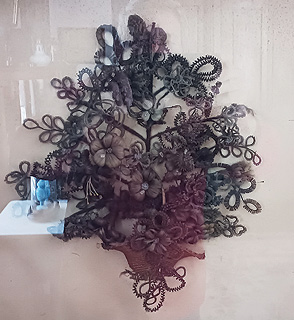
The Salmon Brook Historical Society has two framed hair wreaths in the parlor of the historic Weed-Ender House. These two hair wreaths were made in the mid- to late-nineteenth century and were crafted in memory of members of the Emmons-Case families as well as the Messenger family. During the Victorian Era, hair art was a common way for families to preserve the memory of a loved one.
In the early and mid-nineteenth century, photography was still developing and often too expensive for many families. French inventors Louis Dagurre and Joseph Nicéphore Niépce were among those perfecting early photography techniques; however, portraits were still considered a luxury beyond the reach of many families. As a result, people found other ways to remember those they loved. Hair wreaths became one of those ways.
Locks of hair were carefully woven around fine wire and arranged into decorative shapes, often resembling wreaths or bouquets. The design might include small flowers, beads or bits of jewelry to enhance the piece. Smaller framed pieces usually contained the hair of a single person and were often created in memory of someone who had died, or as a sentimental gift between close friends or family members. Larger wreaths could contain hair from several family members, symbolizing the unity and strength of the family itself.
The idea of preserving hair may seem weird, or even ghoulish, for people of today’s standards. It was commonplace one hundred and fifty years ago. In a time when photography was not available, a lock of hair could serve as one of the few tangible reminders of a loved one.
The practice became especially popular after the death of Prince Albert in 1861. Queen Victoria wore a locket containing Prince Albert’s hair until her death in 1901. Her prolonged mourning helped shape Victorian mourning customs, and many women in the United States also began creating jewelry and decorative pieces from hair as keepsakes.
For some craftsmen, hair work became a small business. Skilled craftsmen produced wreaths, lockets, brooches and other pieces of jewelry using hair provided by the customer. By the early twentieth century photography became more affordable and widely available. As family photographs became easier to obtain, the tradition of hair wreaths declined.
Today hair wreaths or hair art hasn’t completely disappeared. Some craftsmen continue the practice as a historical craft, creating hair wreaths and jewelry for display or sale at craft fairs and flea markets. Historical societies across the United States and Canada preserve many examples of Victorian hair art as reminders of the sentimental traditions of the past.
The Salmon Brook Historical Society’s two hair wreaths offer visitors a rare glimpse into this once commonplace remembrance. Those interested in seeing these items, come tour the Salmon Brook Historical Society, starting Sunday, June 14, 2–4 p.m. Call 860-653-9713 or visit salmonbrookhistoricalsociety.com and become a member.
The hair wreath in the inset photo above was made by Etta Emmons. Photo courtesy of the Salmon Brook Historical Society