
Find it
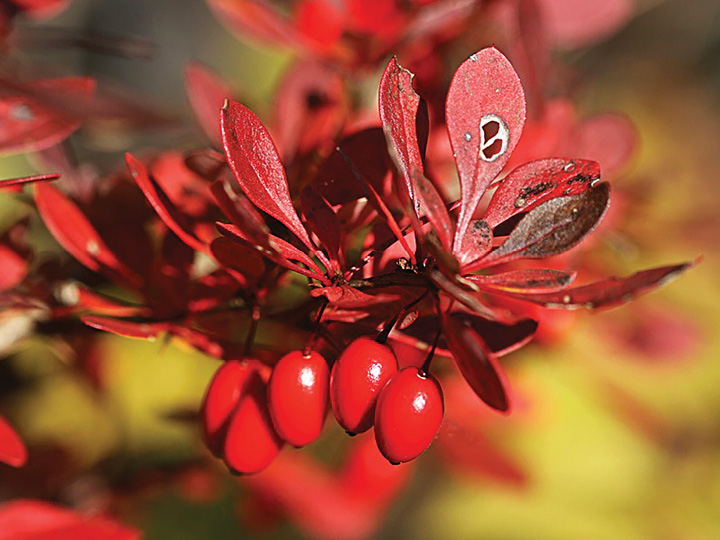
A dense bush usually growing two to five feet tall and wide, Japanese barberry (Berberis thunbergii DC) has spikey thorns every inch or so along each branch. Small leaves along the branches are green in spring and summer. In the fall it’s easy to identify: the leaves turn red, brown, purple and orange; bright red berries hang in rows along the branches into the winter. Over time, it grows into dense and impenetrable thickets, in full sun or in partial forest shade. It tolerates a wide range of growing light, soil and moisture conditions and survives droughts.
Why it’s a problem
Japanese barberry was imported to the US in the late 1800s and widely planted in landscapes, often as hedges to prevent through-passage or in problem areas where other plants did not grow. Once established, it crowds out other plants, changing soil chemistry and inhibiting forest regeneration. It spreads nearby via rhizomes, and by layering, when long branch tips form roots in contact with soil. It spreads widely when birds distribute the seeds that have a high germination rate.
Japanese barberry helps spread Lyme disease: the dense thickets are humid, which the tick larvae need, and provide protection for the white-footed mice that carry the Lyme disease organisms. Deer don’t eat it, focusing instead on tasty native plants.
What to do
Don’t plant it. Due to its carefree nature and brilliant color, Japanese barberry is valued and common in landscaping—outside Granby Memorial High School, for example. While it has long been included on the list of over 100 invasive plants, recent legislation actually bans it from sale, cultivation and distribution in the state as of October 2028. Exceptions to the ban may be allowed for confirmed sterile (seedless) varieties, including four cultivars developed and tested over two decades by Dr. Mark Brand of UConn; these are now available commercially, with names like UCONNBTCP4N.
Remove it. The first priority is to pull or dig out seedlings and small plants by the roots as soon they appear, letting them dry in the sun. Larger plants will likely need a multiple-step approach. Use loppers or a metal brush cutter to cut the plant at the base; dispose of the branches without allowing the seeds to disperse. Then use a propane torch to roast the base and roots; return after several months to repeat as needed. As a last resort, carefully paint the cut stems with a liquid herbicide.
In Avon, the Farmington River Watershed Association, with partner groups and a lot of volunteers, conducted a multi-year test of several all-volunteer removal methods on mature plants in a forest setting at Fisher Meadows. It concluded that the following strategy is most effective and time-efficient. Three to five volunteers gather the stems and pull, while another uses a long crowbar to yank the root ball loose. Soil is knocked off the dense roots, and the plants are piled to dry in the sun. The site needs to be checked several times over the next couple years to remove seedlings and small plants. See later in this month’s issue for a photo of this technique.
Replace it. There are lots of colorful, carefree native plants to replace Japanese barberry, including viburnum, summersweet, blueberry and winterberry. UConn’s Native Plant and Sustainable Landscaping Guide lists many more, and is available on GranbyInvasivePlants.weebly.com, along with more information and photos.