
This column began in 2019 with a series of Invasive of the Month columns focusing on nine of the most common, harmful, difficult-to-control invasive plants in our area. For those who didn’t laminate, frame or memorize those columns, this one restarts the series with updated information.
The 37 Not Wanted columns to date are available at GranbyInvasivePlants.weebly.com, with photos, resources and more, as well as by searching the Granby Drummer website.
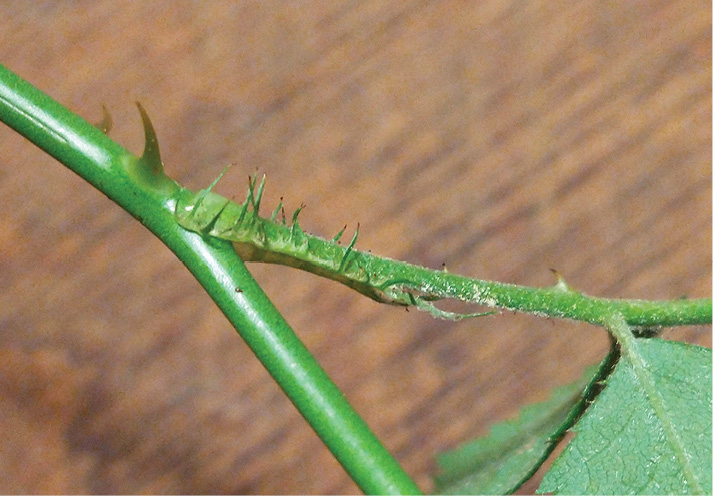
Find it
Multiflora rose (Rosa multiflora) is an extremely vigorous shrub that is particularly hard to control because of its super-sharp, aggressive thorns. These are borne on long, arching branches that grow six feet or more per year in every direction, sometimes climbing through the branches of small trees to 12 feet or more. MF Rose thrives in a wide range of soils and moisture levels; it tolerates shade and explodes in full sun, with single shrubs growing to 12 feet wide or more. When it blooms in late spring, its bright white flower clusters project an intoxicatingly sweet scent.
MF Rose can be reliably distinguished in two ways from the several native roses in our area, such as Carolina rose (Rosa carolina) and Virginia rose (Rosa virginiana). Invasive MF Rose has white clustered flowers, in contrast to natives’ pink flowers. And MF Rose has fringy hairs at the base of the short stems between branch and leaf.
Why it’s a problem
Multiflora rose was imported from Japan in the late 1800s as a rootstock to aid in propagating ornamental roses. GoBotany.org says it was then “promoted as a highway planting, a living fence, an erosion control agent, and a planting to attract wildlife.” It’s very vigorous growth habit, ability to grow in a wide range of soil, water and light conditions and lack of known controls have enabled it to rapidly take over fields and open areas, forming dense, impenetrable mazes that crowd out native plants. Birds and other wildlife eat the small red hips and distribute the seeds. Mature MF Roses produce hundreds of thousands of seeds each year; the seeds can remain viable in the soil for decades.
What to do
Yank the young ones. Like many invasive plants, gaining control over major MF Rose concentrations requires multiple steps over several years. The most effective: pull them up by the roots, especially with small plants: a well-aimed shovel-thrust or weeder-yank can make short work of seedlings and the mid-size plants that grow more weakly in shaded areas. Spring is the best time for this attack, when emerging leaves make plants visible and their hold on the soil is more tenuous; when the soil is moist, the relatively brittle tissue is more likely to be removed intact. Because of the long-enduring seeds, new plants need to be yanked year after year.
Bust the big ones. To attack the trunks and roots of highly fortified mature shrubs, suit up in chain saw chaps or full-body Kevlar to protect delicate human skin from MF Rose’s razor-sharp predatory thorns. Cut the trunks close to the ground from a safe distance with pole saws, long-arm loppers, or brush cutters equipped with a metal blade, and pull the spikey mess to the side. Winter is a great time to tackle mature shrubs because the woody stems, up to two inches thick, are more visible. Early winter action allows multiple snowfalls to flatten the dying branches, making the base more accessible. In the spring, the cut stems and roots can be removed with hand tools like shovels, mattocks or axes, or with a chain-equipped vehicle, removing as much of the roots as possible. As a last resort, carefully paint freshly cut stumps with liquid herbicide.
Multiple mow. Large areas can be mowed or brush-hogged repeatedly, several times a year for several years, to deprive the roots of the fruits of photosynthesis. The Holcomb Farm Tree Trail has completed the first of a multiyear experiment targeting Japanese barberry (Berberis thunbergii) and MF Rose in 800 square yards in the southeast field, surrounding a cluster of native tulip trees (Liriodendron tulipifera). The area is cut twice a month through late June, then monthly through October. The existing woody plants should wither away over two or three years, allowing natives and planted beneficial grasses to take their place. Of course, durable seeds already in the soil, and freshly imported by pooping birds, make eradication unattainable. The goal is control!